

On this page
- Specifications and trade-offs
- A small reachable lawn is the strongest use case
- The width and cutting-height facts to use
- Bagging is the configuration to rely on
- Plan the cord route before choosing the mower
- Weight, collection stops and storage
- Cleaning and blade ownership are still part of the job
- Two alternatives that solve different limitations
- Check supply and the current carton
- Common questions
Specifications and practical trade-offs
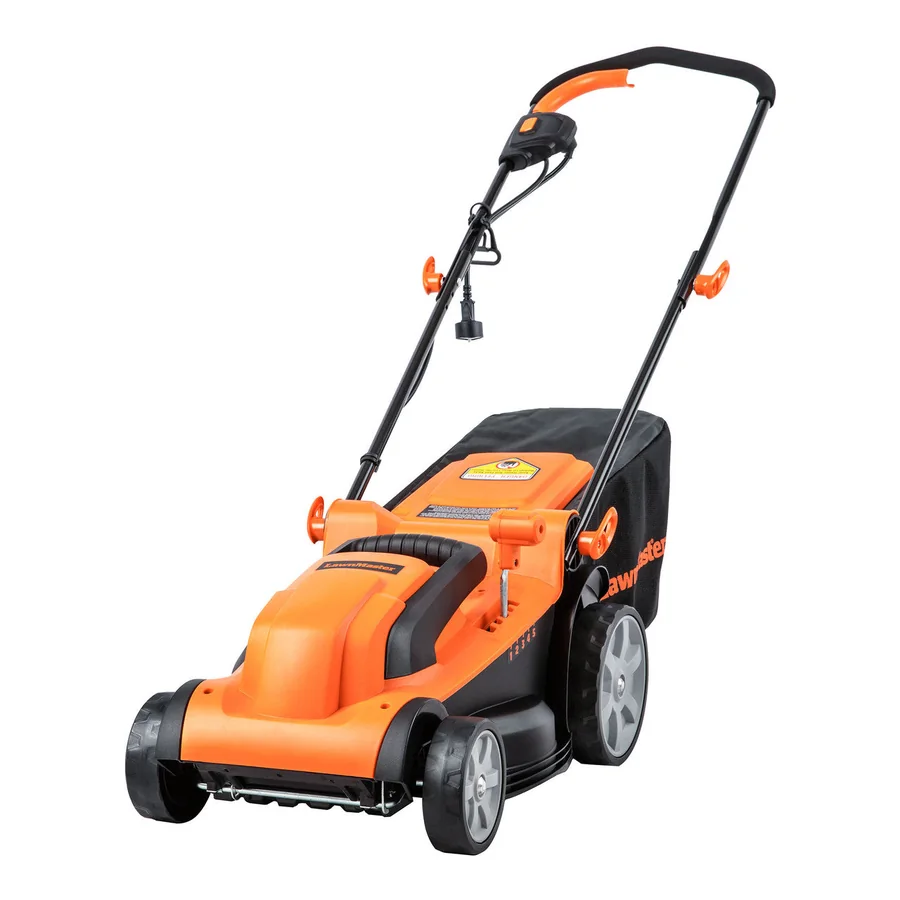
Documented manufacturer and manual information for this exact model. Published weight bases differ; deck size is not automatically cutting width.
| Power / drive | 120V AC, 60Hz, 11A corded; Push |
|---|---|
| Deck / cutting path | 15-inch deck; 14-inch verified cut |
| Included battery | Not applicable |
| Charger | Not applicable |
| Height adjustment | 1.4–3 inches; 5 positions in current manufacturer-linked manual pp3 and17. |
| Published weight | 28 lb. Current official operator manual p3, “Unit Weight”. Product page also gives 28.6 lb in its specifications; do not present these as measured values. |
Supplied equipment: Grass collection bag (7-gallon stated capacity); Upper and lower handle sections; Locking knobs, bolts and cable clips in manual packing list; Operator manual.
Advantages
- Manual verifies 14-inch cutting width separately from the 15-inch deck.
- Published 28 lb unit weight and folding handle suit compact storage.
- Five height positions and supplied grass collection bag.
Drawbacks
- Narrow cut means more passes over open areas.
- Seven-gallon catcher requires more frequent emptying than larger bags.
- Maximum cutting height is 3 inches; check this against the preferred height of your grass.
- Extension-cord management is part of every mow; mulching configuration and current kit contents need seller confirmation.
A small reachable lawn is the strongest use case
A compact corded mower is useful when your mowing area is close to a suitable outlet and the cable can follow a clear route. The MEB1114K’s narrow cut can make sense around small beds and limited spaces, where an extra-wide deck is not the priority. It also avoids the purchase and replacement of a mower battery.
The same configuration becomes less attractive on a large open lawn. A 14-inch path requires more passes than a full-size mower, while the 7-gallon collection bag creates more emptying stops than a large catcher. Trees, a divided front-and-back route or obstacles that catch the cord can outweigh a low purchase price.
Do not choose it merely because a product title says electric. Corded and cordless ownership solve different problems. If outlet access or cable routing is already inconvenient, a small battery mower may improve the routine more than saving on the initial mower package.
The width and cutting-height facts to use
The current manufacturer-linked manual states a 15-inch deck and 14-inch cutting width. That distinction matters when estimating passes or comparing a compact mower with a larger one. A deck is the housing; the product title’s nominal size should not be silently treated as independently measured cutting coverage.
Cleva’s current product page has the deck and cutting widths reversed in one specification list, while its feature bullet agrees with the manual’s 14-inch cut. The manual therefore controls this assessment. Its current height range is 1.4–3 inches in five positions; older mirrored documents stating a 1-inch minimum should not override the linked revision.
The 3-inch maximum deserves a separate check against the height you intend to maintain for your grass. Raising a mower is not only a comfort feature: a mower whose adjustment range misses your preferred setting is a poor fit even if it is easy to push.
| Item | Current manual specification | Buying implication |
|---|---|---|
| Power | 120V AC, 60Hz, 11A | Use the US electrical configuration and exact cord instructions. |
| Deck and cut | 15-inch deck;14-inch cutting width | Compare actual path, not only the title’s nominal size. |
| Height | Five positions, 1.4–3 inches | Check the 3-inch ceiling against your lawn. |
| Collection and weight | 7-gallon bag;28lb unit weight | Published values, not Lawn Current measurements. |
Bagging is the configuration to rely on
The current manual’s carton list identifies the mower, collection bag and metal frame, upper and lower handles, knobs, washers, bolts, cable clips and instructions. Inspect those components before assembly. A suitable extension cord is a separate requirement, and should not be assumed to come in the carton.
The manufacturer page contradicts itself on mulching: its specifications say side discharge and mulching are not supported, while the included-items section names a mulch plug. The linked manual’s packing list does not list that plug or a side chute. This is a reason to verify the supplied unit, not a basis to advertise three clipping modes.
Our assessment therefore centres on collection. If mulching is essential, obtain written clarification for the exact current carton or choose a model with clearly documented equipment. Generic safety wording about discharge openings or clippings does not prove that a particular optional attachment is included.
Plan the cord route before choosing the mower
Walk the path from the outlet to the farthest part of the actual turf, allowing for corners and obstacles. A straight-line distance across a plan can underestimate the cable needed around a building or garden bed. The manual, plug and cord must all support the intended arrangement; extra joined cables are not a substitute for a suitable route.
The manual requires outdoor-use cord provisions and GFCI protection. Its short-length prose is more conservative than its generic gauge table, so do not buy a thin cable based on an isolated row or a universal internet rule. Follow the more conservative printed requirement and ask the manufacturer to resolve uncertain lengths or configurations.
Keep the cord visible and away from the cutting path, and stop before moving or untangling it. Wet operation, damaged insulation and an unsuitable supply defeat the simplicity that makes corded mowing attractive.
Weight, collection stops and storage
The manual publishes a 28-pound unit weight; the product page gives 28.6 pounds elsewhere. These are manufacturer specifications with slightly different reporting, rather than two measurements from our workshop. The mower is compact on paper, but a full bag and a difficult surface still affect how it feels to push.
Folding handles are useful after mowing. Check the handle fasteners and cable routing when folding or opening the machine, then keep it dry and stable. Assembled and folded dimensions were not verified, so an apparent retailer dimension should not be assumed to describe the mower ready for work.
For collection, empty the catcher before accumulated clippings impair the job. Disconnect the supply and wait for the blade to stop before removing the bag or clearing grass. A small catcher is manageable to lift but may interrupt a productive mowing rhythm on a larger lawn.
Cleaning and blade ownership are still part of the job
The manual says not to wash the mower with a hose. Disconnect it before cleaning, inspect the blade and fastening points, and remove clippings using the approved method. A simple electric motor avoids fuel-system service; it does not remove blade care, guard checks or electrical-cord inspection.
Use identical approved replacement parts and match the model when ordering. A generic 14-inch blade is not established as compatible just because its length appears close. Keep the exact manual with the purchase documents, particularly because current product listings contain conflicting specification fields.
A handful of online summaries describe side-discharge use or hose cleaning without matching the linked manual. Those claims are not adopted here. This is a research-based ownership assessment; it does not present assembly time, noise, cut quality or reliability as Steven’s personal test results.
Two alternatives that solve different limitations
If the MEB1114K’s limits conflict with your lawn, choose the alternative that addresses the specific problem. Compare complete equipment and service support, rather than assuming the cheapest visible listing is the lowest ownership cost.
| Alternative | Why choose it | Trade-off |
|---|---|---|
| BLACK+DECKER MM2000 | A full-size corded option with clearly documented bagging, mulching and side discharge. | Larger mower; its 13A load has different manual-permitted cord requirements. |
| WORX WG779 | Small-yard battery mowing when cable routing is the main obstacle. | Two batteries required for its 40V MAX arrangement; a 13-inch cutting diameter and charging to manage. |
Check supply and the current carton
Amazon links here search for the exact model. Confirm the current offer, carton contents, seller and return terms before paying. A matching product name alone does not establish that the pictured attachments are included or that the seller has the mower in stock.
Use the corded mower buying guide to compare wider alternatives, or the main electric mower guide if cordless convenience would improve your route.
- Match MEB1114K and the current manual; use 14-inch cut and 1.4–3-inch height range.
- Confirm collection equipment and any claimed mulch plug directly with the seller.
- Budget for the correct outdoor cord and check the electrical route.
- Check the 3-inch maximum height and realistic bag-emptying frequency.
Common questions
Is the cutting width 14 or 15 inches?
The current official manual separates a 15-inch deck from a 14-inch cutting width. A reversed specification field on the product page is not used to promise a wider cut.
Can it mulch or side discharge?
Those functions are not established consistently for the current carton. The product page says they are unsupported but also lists a mulch plug. Verify the actual configuration before relying on either.
Is an extension cord included?
Do not assume so. The current manual’s packing list does not identify an extension cord; choose one permitted by the exact electrical and outdoor-use instructions.
What is the maximum cutting height?
The current manufacturer-linked manual specifies 3 inches, with five settings starting at 1.4 inches. Check that range against the height you want for your grass.
Documentation and attribution: sources for this article. How we evaluate mowers.

Written by Steven Burt
Lawn care enthusiast in Nixa, Missouri, and owner of Lawn Current. Meet Steven · Suggest a correction